Annual Report · Edition 3 · Published May 4, 2026 · Restated July 29, 2026 and September 15, 2026 · Methodology
Virginia Criminal Court Outcomes
376,712 cases filed January 1 – December 31, 2025, across 125 jurisdictions · District Court record as of August 24, 2026; Circuit Court record through July 9, 2026
Edition 3, released September 15, 2026. This edition is frozen: its figures do not change until the next edition is released. What changed from the previous edition · Before-and-after figures.
This report analyzes 376,712 criminal cases — misdemeanors and felonies across 25 named charge categories — filed in Virginia's district and circuit courts during calendar year 2025. Of the 293,408 that reached a final disposition, 40.2% did not result in conviction.
Published by VirginiaCourtFile.com from public Virginia court records. Every statistic is re-derivable from the source data via the methodology. This is Edition 3: District Court record as of August 24, 2026, Circuit Court record through July 9, 2026.
The data is drawn from the same public case information system used by attorneys, clerks, and the courts. Every number in this report is derived from that source. Where the data does not support a conclusion, we say so.
The report covers misdemeanor and felony criminal cases filed in 2025 — not traffic infractions, not the catch-all "Other" category, not failure-to-appear warrants, and not probation-revocation dockets, which resolve by revocation rather than dismissal or conviction. What remains is 376,712 cases where a defendant faced a specific criminal allegation under a specific Virginia Code section.
Eight findings follow.
In this report
- Nearly half of resolved criminal cases do not result in conviction
- Charge type is the strongest predictor of dismissal rate in this data
- Felonies are dismissed at higher rates than misdemeanors
- In circuit court, 90.8% of convictions are guilty pleas
- In circuit court, acquittal rates at trial vary dramatically by charge
- Some courts are prosecutor-driven; others are judge-driven
- Jurisdictional variation spans a 12:1 range
- Demographics of the charged population
1. Nearly half of resolved criminal cases do not result in conviction
Of 293,408 criminal cases that reached a final disposition in 2025:
- 24.0% ended in nolle prosequi — the Commonwealth's Attorney declined to proceed
- 14.3% were dismissed by the court
- 1.9% resulted in acquittal
- 59.8% resulted in conviction
The 40.2% non-conviction rate is a statewide aggregate. It varies substantially by charge type (from 13.6% for dui / dwi to 78.9% for kidnapping / abduction), by court level (36.4% for misdemeanors, 55.7% for felonies), and by jurisdiction (from 5.4% to 66.2% across courts with 500+ resolved cases). Each of those dimensions is examined below.
2. Charge type is the strongest predictor of dismissal rate in this data
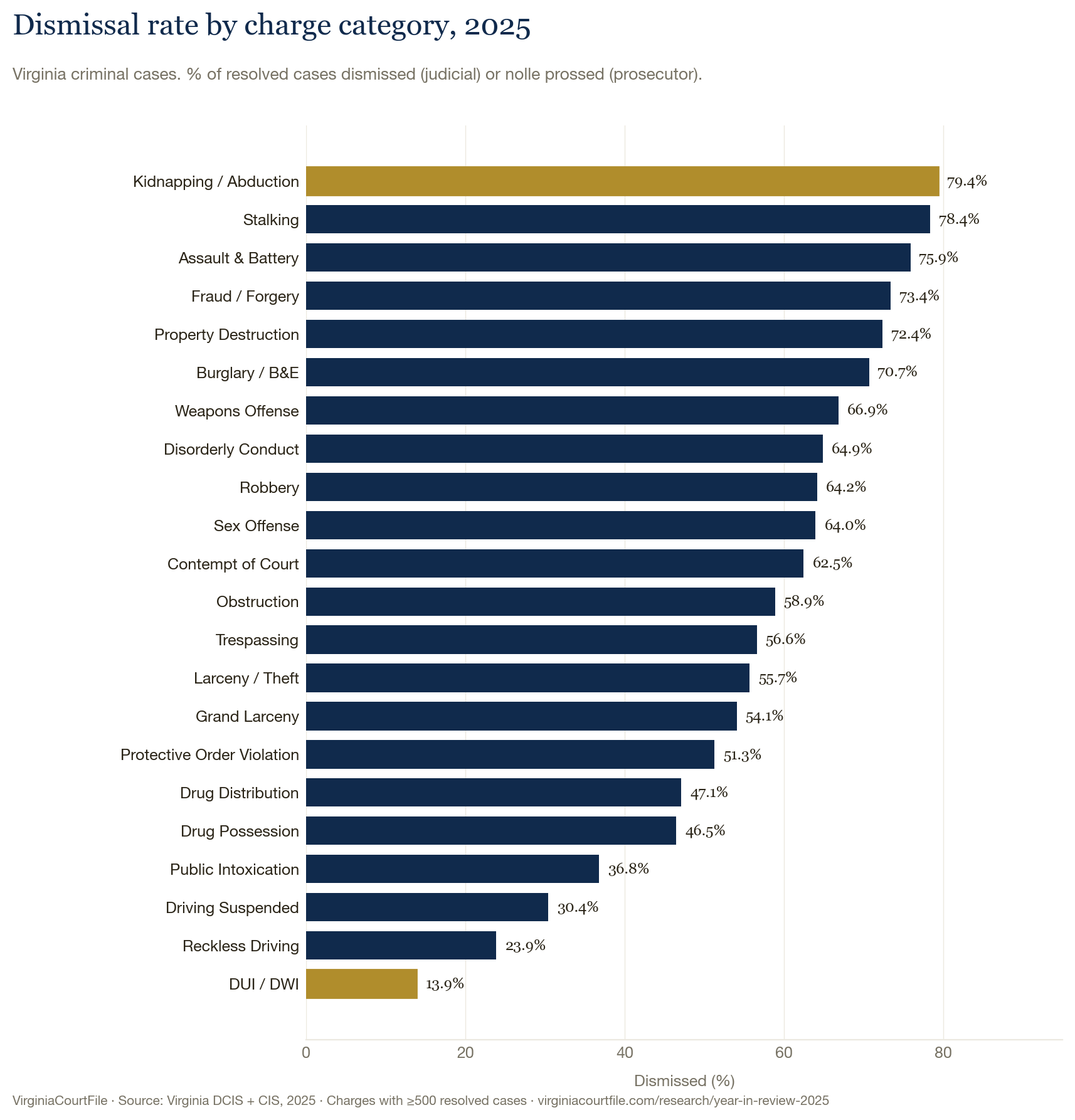
| Charge | Cases | Resolved | Dismissed | Reduced |
|---|---|---|---|---|
| Kidnapping / Abduction | 1,630 | 1,079 | 7.2% | |
| Stalking | 1,087 | 870 | 2.3% | |
| Fraud / Forgery | 14,120 | 9,158 | 4.4% | |
| Assault & Battery | 24,629 | 18,149 | 6.8% | |
| Property Destruction | 8,095 | 5,837 | 6.0% | |
| Burglary / B&E | 1,640 | 1,102 | 7.4% | |
| Weapons Offense | 23,678 | 14,863 | 6.4% | |
| Disorderly Conduct | 2,954 | 2,479 | 0.8% | |
| Contempt of Court | 4,632 | 3,606 | 0.3% | |
| Robbery | 2,305 | 1,373 | 20.2% | |
| Obstruction | 10,018 | 7,473 | 1.9% | |
| Trespassing | 13,833 | 11,881 | 0.2% | |
| Drug Distribution | 9,331 | 5,044 | 12.3% | |
| Larceny / Theft | 41,031 | 30,650 | 3.6% | |
| Sex Offense | 8,187 | 4,786 | 7.3% | |
| Grand Larceny | 4,089 | 2,488 | 16.3% | |
| Protective Order Violation | 919 | 691 | 3.2% | |
| Drug Possession | 29,877 | 15,185 | 16.2% | |
| Public Intoxication | 19,805 | 15,609 | 0.1% | |
| Driving Suspended | 27,317 | 23,990 | 19.0% | |
| Reckless Driving | 101,756 | 96,583 | 45.7% | |
| DUI / DWI | 24,003 | 19,571 | 30.8% |
Misdemeanor and felony case types only. Charges with fewer than 500 resolved cases omitted for readability. Figures are as of this edition (record August 24, 2026); the linked charge pages carry the site's current data release and may differ by tenths. Full data at /charges.
The range is wide: from 13.6% (DUI / DWI) to 78.9% (kidnapping / abduction). The highest dismissal rates are in kidnapping / abduction (78.9%), stalking (78.2%), and fraud / forgery (72.1%). The lowest are in DUI / DWI (13.6%), reckless driving (19.7%), and driving suspended (30.8%). The data does not capture why these charge types differ — evidence standards, prosecutorial priorities, and plea practice all vary by offense, and none of that is recorded.
Dismissal rate and reduction rate move inversely. Charges with low dismissal rates tend to have high reduction rates (reckless driving: 19.7% dismissed, 45.7% reduced; DUI / DWI: 13.6% dismissed, 30.8% reduced). Charges with high dismissal rates tend to have low reduction rates (fraud / forgery: 72.1% dismissed, 4.4% reduced). Where a charge is rarely dropped, negotiation happens on the charge itself.
A detailed jurisdictional analysis of DUI/DWI — the charge with the lowest dismissal rate and one of the highest reduction rates — is available in the companion DWI report.
3. Felonies are dismissed at higher rates than misdemeanors
Misdemeanor
Felony
Felony cases are dismissed at a rate 19 percentage points higher than misdemeanors (55.7% vs 36.4%). The gap is driven by prosecutorial nolle prosequi: prosecutors decline to proceed on a substantially higher share of resolved felony cases than misdemeanor cases.
Of the 99,869 felony cases filed in 2025, 54,110 (54.2%) had reached a final disposition as of the August 24, 2026 record. The remainder include cases certified from district court to circuit court (which continue in circuit court and may not yet be resolved) and other pre-disposition statuses. All rates in this finding divide by resolved cases only.
4. In circuit court, 90.8% of convictions are guilty pleas
Virginia's case records distinguish a guilty plea from a conviction at trial only in circuit court. The General District Courts — which handle the majority of criminal and traffic matters — record a conviction simply as "guilty," without noting whether it followed a plea or a bench trial. A statewide plea rate therefore cannot be computed from the public record.
Circuit Court record through July 9, 2026. Among circuit-court convictions in this report's universe, where the distinction is recorded, 25,833 of 28,455 (90.8%) were guilty pleas and 2,622 (9.2%) were findings of guilt at trial.
This is a limitation of the source records, not a finding about the cases: most district-court convictions are in fact uncontested, but the records do not capture the mechanism, so we report the plea-versus-trial split only where Virginia's data actually distinguishes it.
5. In circuit court, acquittal rates at trial vary dramatically by charge
Because the plea-versus-trial distinction is recorded only in circuit court (see Finding 4), trial outcomes can be measured reliably only there; the Circuit Court record runs through July 9, 2026. Among 3,385 circuit-court trials in 2025 — findings of guilt plus acquittals — 763 (22.5%) ended in acquittal, and the rate varied widely by charge.
| Charge | Circuit trials | Acquittals | Acquittal rate |
|---|---|---|---|
| Kidnapping / Abduction | 57 | 33 | 57.9% |
| Murder / Manslaughter | 56 | 29 | 51.8% |
| Protective Order Violation | 54 | 26 | 48.1% |
| Assault & Battery | 456 | 208 | 45.6% |
| Weapons Offense | 298 | 123 | 41.3% |
| Obstruction | 79 | 26 | 32.9% |
| Grand Larceny | 61 | 19 | 31.1% |
| Fraud / Forgery | 98 | 23 | 23.5% |
| Larceny / Theft | 135 | 23 | 17.0% |
| DUI / DWI | 156 | 26 | 16.7% |
| Sex Offense | 339 | 53 | 15.6% |
| Drug Possession | 294 | 40 | 13.6% |
| Contempt of Court | 244 | 22 | 9.0% |
| Drug Distribution | 106 | 9 | 8.5% |
| Driving Suspended | 96 | 7 | 7.3% |
| Reckless Driving | 613 | 15 | 2.4% |
"Circuit trials" = acquittals + findings of guilt at trial in circuit court (excludes guilty pleas, and all district-court dispositions, which do not distinguish plea from trial). Charges with fewer than 50 circuit trials omitted; aggregate categories excluded as in the rest of this report.
The highest acquittal rates at trial are in kidnapping / abduction (57.9%), murder / manslaughter (51.8%), and protective order violation (48.1%). The lowest are in reckless driving (2.4%), driving suspended (7.3%), and drug distribution (8.5%). Trial counts are small for several charges, so a single year's rate can move several points from one year to the next.
The data does not capture why individual trials end in acquittal. It shows only the rate at which they do, by charge type, in circuit court.
6. Some courts are prosecutor-driven; others are judge-driven
The statewide ratio of nolle prosequi to judicial dismissal is 1.7:1 — prosecutors drop more cases than judges dismiss. But this ratio varies from 0.3:1 to 7.3:1 across the 47 jurisdictions with 2,000+ resolved cases, revealing structurally different court systems operating under the same statute.
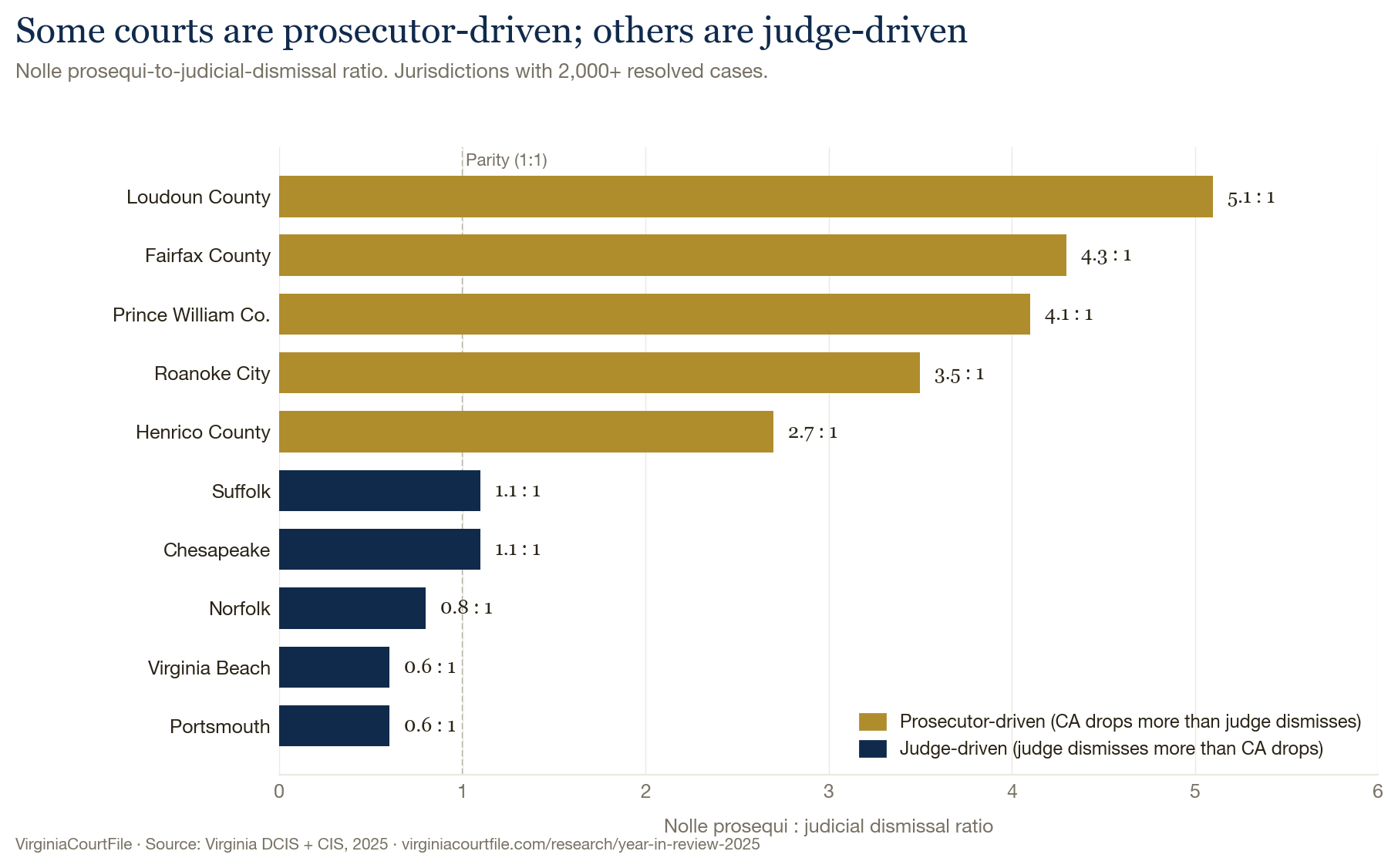
Most prosecutor-driven
Most judge-driven
Ratio = nolle prosequi count / judicial dismissal count. Jurisdictions with 2,000+ resolved criminal cases only.
In Williamsburg, for every case a judge dismisses, the Commonwealth's Attorney drops 7.3. In Northampton County, for every case a judge dismisses, the Commonwealth's Attorney drops 0.3 — judges dismiss more than prosecutors. This is a structural difference in how these courts operate, visible only when the two dismissal paths are counted separately.
7. Jurisdictional variation spans a 12:1 range
Among 98 jurisdictions with 500 or more resolved criminal cases, the overall dismissal rate ranged from 5.4% (Brunswick County) to 66.2% (Richmond City). The ten highest-volume jurisdictions:
| Jurisdiction | Cases | Resolved | Dismissed | Nolle prosequi |
|---|---|---|---|---|
| Fairfax County | 27,838 | 23,858 | 40.0% | |
| Virginia Beach | 17,586 | 13,288 | 11.3% | |
| Prince William County | 16,078 | 12,743 | 35.6% | |
| Henrico County | 15,612 | 12,227 | 22.8% | |
| Chesterfield County | 14,060 | 10,791 | 29.5% | |
| Richmond City | 12,159 | 9,653 | 30.9% | |
| Newport News | 10,921 | 8,313 | 32.4% | |
| Norfolk | 10,805 | 8,497 | 25.2% | |
| Chesapeake | 8,131 | 5,390 | 24.2% | |
| Loudoun County | 7,352 | 6,166 | 31.0% |
Figures are as of this edition (record August 24, 2026); the linked court pages carry the site's current data release.
Fairfax County, the highest-volume jurisdiction (27,838 criminal cases), has a 50.0% dismissal rate. Virginia Beach, the second-highest-volume jurisdiction (17,586 cases), has a 30.1% rate. The data does not explain the difference.
The 12:1 ratio between the highest and lowest jurisdiction dismissal rates (66.2% vs 5.4%) exceeds the variation observed within any single charge type. Full jurisdiction-level data is available at /courts.
8. Demographics of the charged population
Gender and race data are recorded for nearly all cases in this dataset. This finding describes who enters Virginia's criminal court system as recorded in public case data. It does not describe who commits crimes. Court records reflect enforcement decisions, charging decisions, and systemic factors not captured in disposition data.
Gender
Male
Female
Male defendants account for 73.3% of criminal cases. Female defendants account for 26.6%. The remaining 0.1% are recorded as "Other (Includes Not Applicable, Unknown)" or unrecorded.
Race
With that limitation stated, the race field as recorded:
| Race (as recorded) | Cases | % of cases |
|---|---|---|
| White | 200,060 | 53.1% |
| Black | 155,486 | 41.3% |
| Asian / Pacific Islander | 5,240 | 1.4% |
| American Indian / Alaska Native | 562 | 0.1% |
| Hispanic or Latino | 28 | 0.0% |
| Unknown / Other / Unrecorded | 15,336 | 4.1% |
"Black" combines entries recorded as "Black" and "Black Or African American"; the Asian / Pacific Islander and American Indian / Alaska Native rows likewise combine the clerk spellings of each. Race as recorded in the court system; does not reliably capture ethnicity.
Outcome rates by race. Among resolved cases where race is recorded as White or Black:
| Race | Resolved | Dismissal rate | Nolle rate | Acquittal rate |
|---|---|---|---|---|
| White | 154,674 | 37.9% | 22.7% | 1.7% |
| Black | 120,735 | 44.9% | 27.2% | 2.3% |
The dismissal rate for cases recorded as Black (44.9%) is 7.0 percentage points higher than for cases recorded as White (37.9%). This does not mean the system treats Black defendants more favorably — the two groups are charged with different offenses at different rates, and those offenses have different baseline dismissal rates (Finding 2). A charge-adjusted comparison is outside the scope of this report.
This report presents the demographic data as recorded. It does not compute overrepresentation ratios because the ethnicity recording gap makes such comparisons unreliable. Researchers working with this data should account for the Hispanic/Latino classification issue before drawing population-level conclusions.
What does this report cover — and what are its limits?
This report analyzes the 376,712 misdemeanor and felony cases filed in Virginia's public court records during calendar year 2025, across 125 jurisdictions in both court systems; it excludes traffic infractions, unclassified "Other" charges, failure-to-appear warrants, and probation-revocation dockets, and its rates describe historical patterns — they are not predictions about any individual case.
Coverage. 376,712 criminal cases classified as misdemeanor or felony in Virginia's public court records, filed January 1 – December 31, 2025. 25 named charge categories across 125 jurisdictions in both district and circuit courts. District Court record as of August 24, 2026; Circuit Court record through July 9, 2026; Edition 3 released September 15, 2026.
Excluded. Traffic infractions (815,817 cases); the "Other" charge category (603,884 cases of all types); failure-to-appear warrants (34,759 cases); probation-revocation dockets (57,800 cases), which resolve by revocation rather than by dismissal or conviction. Including these would inflate the case count without adding interpretive clarity to the criminal-charge analysis.
A note on the "Other" exclusion. The "Other" charge category aggregates charges our taxonomy does not yet classify into named categories. Future editions will narrow it as classification coverage grows; the July 29 statute-first release already moved roughly 150,000 cases out of catch-all categories and into named offences.
Definitions. Resolved = case reached a final disposition (dismissed, nolle prosequi, acquitted, guilty plea, or found guilty). Dismissed in the tables above = nolle prosequi + judicial dismissal + acquittal, reported separately where the text distinguishes them. Reduced = original charge amended to a lesser offense at disposition, counted among convictions. Every rate divides by resolved cases unless stated otherwise.
Unit of analysis. Each row in the dataset is a charge, not a case. In this dataset, the overwhelming majority of case numbers appear only once. Multi-charge cases do not materially affect per-charge rates.
Demographic data. Race and gender are analyzed in Finding 8. Race is recorded for nearly all cases, but the ethnicity field is unreliable — only 28 cases are recorded as Hispanic/Latino in a state with ~10% Hispanic population (see Finding 8 for details). Gender is recorded for all cases. Researchers should treat the race field as the clerk's entry, not a demographic measurement.
What this data does not capture. Plea negotiation dynamics, evidence quality, witness cooperation, judicial reasoning, the specific facts of individual cases, whether defendants were represented by counsel, income, or prior criminal history. The data shows what happened; it does not show why.
Baseline year. This is the first year of this dataset. A same-age comparison of the first half of 2026 with the first half of 2025 is published separately; full year-over-year comparison will be possible when 2026 data collection is complete.
Full methodology at /methodology.
Cite this edition: VirginiaCourtFile.com, "Virginia Criminal Court Outcomes, 2025," Edition 3 (released September 15, 2026; record as of August 24, 2026). virginiacourtfile.com/research/year-in-review-2025. Editions are frozen: the figures above will not change until the next edition is released and dated here.
Related: Virginia DWI Court Outcomes: A 2025 Jurisdictional Analysis · Virginia District Court Outcomes, First Half of 2026
Data last updated: August 24, 2026 · VirginiaCourtFile.com · Contact