Research Report · Edition 3 · Published May 4, 2026 · Restated July 30, 2026 and September 17, 2026 · Methodology
Virginia DWI Court Outcomes
A jurisdictional analysis of 24,003 cases filed in 2025 · District Court record as of August 24, 2026; Circuit Court record through July 9, 2026
Edition 3, released September 17, 2026. This edition is frozen: its figures do not change until the next edition is released. What changed from the previous edition · Before-and-after figures.
The same DUI charge under Va. Code §18.2-266 carries the same maximum penalties everywhere in Virginia. The court outcomes are not the same. Among the 82 jurisdictions with 50+ resolved cases, the share of resolved DUI cases that did not end in conviction in 2025 ranged from 2.7% to 35.1%.
This analysis covers 24,003 DUI/DWI cases filed across Virginia jurisdictions during calendar year 2025: 21,294 in district court (where most DUI cases begin) and 2,709 in circuit court (felony DUI, appeals, and certified cases). 19,571 had reached a final disposition as of this edition's record; every rate below is a share of those resolved cases, or of convictions where stated, never of cases filed.
How to read "dismissed" in this report. In the tables, dismissed means any outcome other than conviction: nolle prosequi (the prosecutor dropped the charge), judicial dismissal, or acquittal. Statewide that was 13.6% of resolved DUI cases — 9.8% nolle prosequi, 2.1% judicial dismissal, 1.7% acquittal. The components are reported separately wherever they differ in meaning.
Published by VirginiaCourtFile.com from public Virginia court records. Every statistic is re-derivable from the source data via the methodology. This is Edition 3: District Court record as of August 24, 2026, Circuit Court record through July 9, 2026.
Eight findings follow; a ninth, on counsel type, has been withdrawn and the reason is given in its place.
1. Jurisdictional variation in dismissal rates is wide
The statewide non-conviction rate for DUI/DWI cases was 13.6% of resolved cases. That average conceals wide variation across individual jurisdictions.
Whether this variation reflects differences in prosecutorial policy, judicial practice, local defense bar activity, case demographics, or some combination is not determinable from disposition data alone. What is determinable: the variation is large and not explained by the charge itself, which is uniform statewide under the same statute. The smallest jurisdictions in the table rest on few cases — Lancaster County's rate is computed on 57 resolved cases — so single-year differences among them should be read with that in mind.
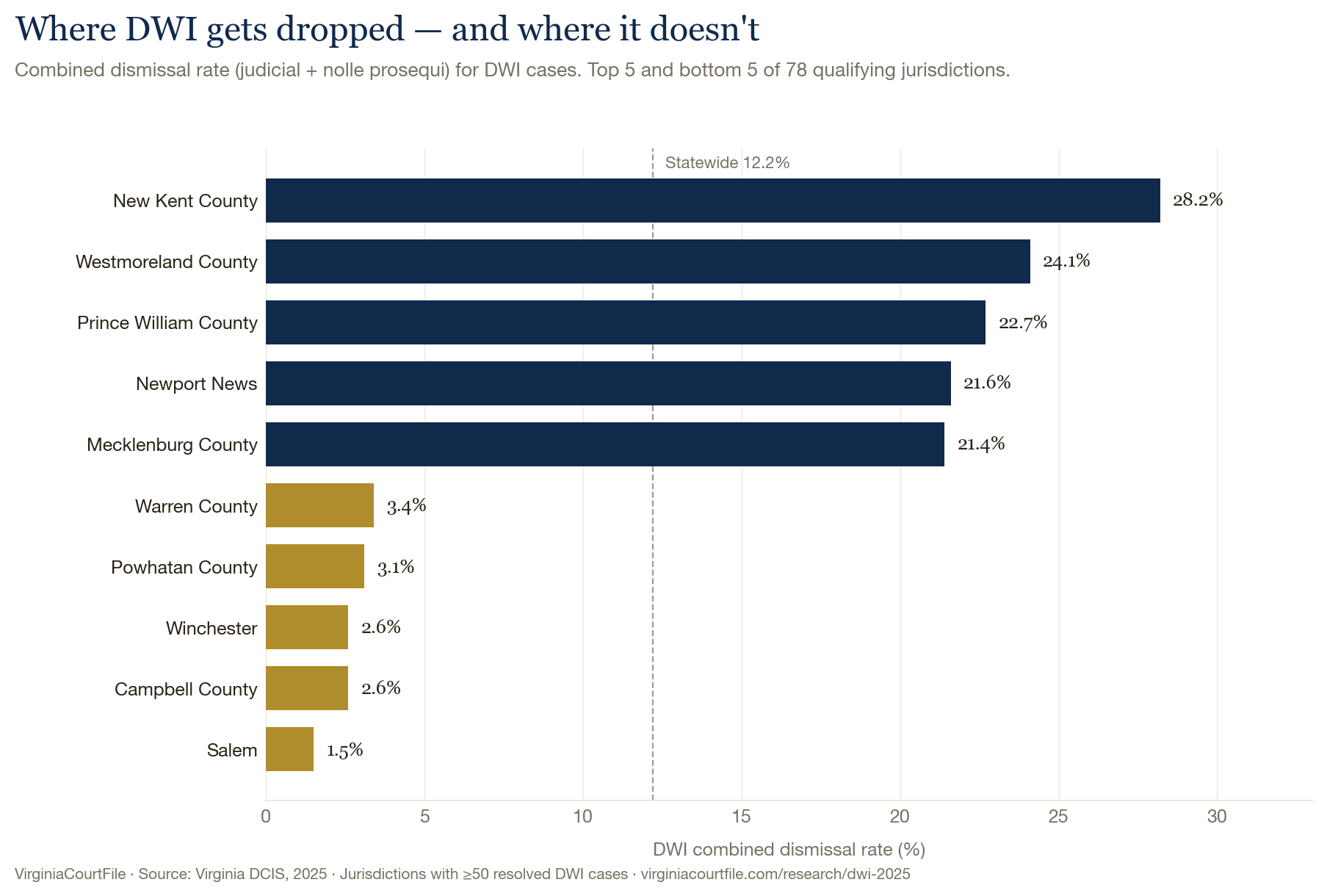
| Jurisdiction | DUI cases | Resolved | Dismissed | Amended |
|---|---|---|---|---|
| Lancaster County | 68 | 57 | 35.1% | 8.1% |
| Westmoreland County | 116 | 96 | 29.2% | 50.0% |
| Prince William County | 1,254 | 987 | 26.5% | 53.7% |
| Petersburg | 91 | 74 | 24.3% | 44.6% |
| Newport News | 673 | 562 | 24.2% | 35.2% |
| … | ||||
| Winchester | 107 | 90 | 3.3% | 34.5% |
| Dinwiddie County | 75 | 62 | 3.2% | 20.0% |
| Warren County | 195 | 162 | 3.1% | 31.8% |
| Waynesboro | 92 | 70 | 2.9% | 26.5% |
| Salem | 84 | 73 | 2.7% | 46.5% |
Dismissed = non-conviction share of resolved cases. Amended = share of convictions entered on an amended charge (see Finding 4 for what that does and does not mean). Jurisdictions with fewer than 50 resolved DUI/DWI cases excluded. Figures are as of this edition (record August 24, 2026); the linked charge pages carry the site's current data release and may differ by tenths. All 82 jurisdictions at the DUI/DWI charge page.
The two measures do not move together. Powhatan County shows a 4.0% non-conviction rate, and 51.4% of its DUI convictions were entered on an amended charge. Salem shows a 2.7% non-conviction rate, and 46.5% of its DUI convictions were entered on an amended charge. Different courts resolve cases through different mechanisms, and a court that rarely dismisses outright may still record amended charges often.
2. Prosecutors, not judges, drive most DUI dismissals
The 13.6% statewide non-conviction rate is made of distinct mechanisms with different implications:
Nolle prosequi
Judicial dismissal
Nolle prosequi accounts for the majority of DUI non-convictions. The data does not capture the reasons behind individual nolle prosequi decisions, but the aggregate is clear: statewide, prosecutors dropped 4.7 DUI cases for every one a judge dismissed (1,924 nolle prosequi and 407 judicial dismissals on 19,571 resolved cases; a further 335 ended in acquittal).
That ratio varies by court. The ten largest district-court DUI dockets:
| Jurisdiction | Resolved (district) | Nolle prosequi | Judicial dismissal |
|---|---|---|---|
| Fairfax County | 1,843 | 14.4% | 1.6% |
| Virginia Beach | 1,131 | 4.4% | 1.1% |
| Prince William County | 947 | 20.6% | 2.3% |
| Chesterfield County | 894 | 9.6% | 1.3% |
| Henrico County | 611 | 7.4% | 2.9% |
| Loudoun County | 610 | 10.5% | 2.6% |
| Newport News | 518 | 20.3% | 2.5% |
| Arlington County | 443 | 8.8% | 3.2% |
| Stafford County | 407 | 11.3% | 2.0% |
| Montgomery County | 399 | 7.5% | 1.3% |
District court only; rates are shares of resolved district-court DUI cases in each jurisdiction.
Among these ten, Prince William County is the most prosecutor-driven: 8.9 nolle prosequi for every judicial dismissal. Virginia Beach has the lowest district-court non-conviction rate of the ten (6.2%), and Prince William County the highest (26.2%).
3. District court and circuit court are structurally different proceedings
Virginia DUI cases appear in both court systems. District courts handle misdemeanor DUI (the vast majority). Circuit courts handle felony DUI (third or subsequent offenses), appeals from district court, and cases certified up from preliminary hearings.
District court
Circuit court
The district-court non-conviction rate is 2.7 percentage points above the circuit-court rate (13.9% vs 11.2%), and the amended-charge rate diverges more sharply: district-court convictions were entered on an amended charge 2.2 times as often as circuit-court convictions (37.9% vs 17.2%). The difference in case composition — felony DUI and repeat offenses reaching circuit court — is a likely contributor, though the data does not directly test this. The Circuit Court record in this edition runs through July 9, 2026.
Combining these two court types into a single rate would obscure the distinct dynamics at work. A first-offense defendant in district court faces a structurally different proceeding than a third-offense defendant in circuit court, even if both are charged under the same statute.
4. 35.6% of DUI convictions were entered on an amended charge; 15.3% left the DWI statute
Among 16,905 DUI cases that ended in conviction, 6,019 (35.6%) carry an amended charge in the court record. An amended charge is not always a lesser one, and for DUI the distinction matters. The record sorts those 6,019 convictions into two groups:
Amended out of the DWI statute
Amended within the DWI statute
The most common destination outside the statute is reckless driving (2,295 convictions; Va. Code §46.2-852, a Class 1 misdemeanor without the license and ignition-interlock consequences that attach to a DUI conviction). Within the statute, 985 convictions moved to a lower offense level (a second offense amended to a first, for example) and 817 dropped an elevated blood-alcohol specification, both of which change the mandatory minimum a defendant faces. In 1,564 the amended charge shows no difference in offense level or BAC specification from the original — in 1,030 of them the text is identical — so the record does not show what changed. Earlier editions of this report described the whole 35.6% as reductions to a lesser charge; the record supports that description for only part of it.
The amended-charge rate is not evenly distributed:
Highest amended-charge rates
Lowest amended-charge rates
Among the 77 jurisdictions with 50+ DUI convictions in 2025. Amended-charge rate = share of convictions entered on an amended charge, of any kind.
In Fairfax County, 82.6% of DUI convictions were entered on an amended charge. In Charlottesville, 3.5%. Same statute, same state.
5. DUI outcomes differ by region
Grouping jurisdictions into four regions shows the variation is not only court-by-court:
Pooled rates: dismissed = non-convictions as a share of all resolved DUI cases in the region (Northern Virginia 5,650, Hampton Roads 4,000, Richmond Metro 2,988, Southwest VA 829); amended = share of the region's DUI convictions entered on an amended charge. Regional groupings are editorial and cover 11, 11, 12, 15 jurisdictions respectively; the rest of the state is not shown.
Northern Virginia has the highest non-conviction rate (17.9%) and Richmond Metro the lowest (12.1%). Northern Virginia has the highest amended-charge rate (55.6%) and Hampton Roads the lowest (22.5%). The causes of these regional differences are not determinable from disposition data, and a regional rate is weighted toward its largest courts.
6. The counsel comparison has been withdrawn
Earlier editions of this report compared outcomes for cases with a private attorney, a public defender, and no attorney listed. That comparison is withdrawn in Edition 3. The court record does not state counsel type; it was inferred from the attorney's name. The inference cannot separate retained counsel from court-appointed private counsel, and checks against public-defender office rosters have found attorneys carrying the wrong label. A table built on that label invites a conclusion about what kind of counsel produces what kind of outcome, and the record cannot support one. The same comparison was removed from this site's charge pages for the same reason.
What the record does show about representation — the named attorney of record on each case — is published on the individual attorney pages, without a comparison between kinds of counsel.
7. In circuit court, few DUI cases go to trial
Virginia's case records distinguish a guilty plea from a trial conviction only in circuit court; the General District Courts, where most DUI cases resolve, record a conviction simply as "guilty," so a statewide DUI plea rate cannot be computed. Among 1,884 circuit-court DUI convictions in 2025, 1,754 (93.1%) were guilty pleas and 130 (6.9%) were findings of guilt at trial. The Circuit Court record runs through July 9, 2026.
Because plea-versus-trial is recorded only in circuit court, the amended-charge rate (35.6% of DUI convictions, Finding 4) is the main measurable trace of case negotiation across all courts in the disposition data.
Two jurisdictions with the same non-conviction rate can differ widely in how often convictions are entered on an amended charge. The amended-charge rate captures variation that the non-conviction rate alone does not.
8. Second-offense convictions are amended more often than first-offense convictions
Charge text in the court records allows a partial classification of offense level. Among cases where offense level could be determined:
| Offense level | Cases | Resolved | Dismissed | Amended |
|---|---|---|---|---|
| 1st offense | 18,506 | 15,589 | 13.4% | 32.9% |
| 2nd offense | 3,274 | 2,717 | 11.5% | 50.2% |
| 3rd or subsequent offense | 1,496 | 791 | 12.8% | 41.6% |
Offense level derived from charge description text (e.g., "DWI, 1ST", "DWI, 2ND", "DWI, 3RD/SUB"). 727 cases whose description does not state an offense level are excluded. Dismissed = non-conviction share of resolved cases; Amended = share of convictions entered on an amended charge.
50.2% of second-offense convictions were entered on an amended charge, against 32.9% of first-offense convictions. Under Va. Code §18.2-270, a second DUI conviction within five or ten years carries mandatory minimum jail time, and Finding 4 shows that amendment to a lower offense level is one of the recorded routes. The disposition data does not reveal why a given charge was amended.
Non-conviction rates are similar across offense levels (11.5%–13.4%).
9. Case duration varies by outcome
The statewide median time from filing to disposition for resolved DUI cases was 119 days (25th percentile 76 days, 75th percentile 183 days).
| Outcome | Cases | Median days |
|---|---|---|
| Convicted on the original charge | 10,881 | 113 |
| Convicted on an amended charge | 6,019 | 126 |
| Not convicted (nolle prosequi, dismissal, acquittal) | 2,659 | 128 |
Duration analysis is restricted to resolved cases with a valid disposition date: 19,559 of 19,571. Cases filed late in 2025 that are still open are not in this measure, so the median will lengthen as the 2025 record matures.
Per-jurisdiction time-to-disposition figures for DUI cases are on the DUI/DWI charge page and individual court pages.
What are the limitations of this analysis — and what comes next?
VirginiaCourtFile's analysis of 2025 Virginia DUI/DWI court outcomes has four principal limitations: it covers a single calendar year, so it cannot establish year-over-year trends; 4,432 of the 24,003 cases filed had not reached a final disposition in this edition's record; it records what happened in each case, not why; and it does not capture case severity (BAC level, accident involvement, prior record) except where the charge text states it. Each limitation — and the future analysis that would address it — is detailed below.
- Year-over-year trend. 2025 is the first year of this dataset. Whether the jurisdictional patterns described here are stable, widening, or narrowing requires at minimum a second year of comparison data. That analysis will follow when the 2026 data is complete.
- An unfinished record. Rates are computed on resolved cases only. Cases still pending, certified to circuit court, or otherwise without a final disposition are outside every rate here, and the Circuit Court record stops at July 9, 2026. Figures will move when the next edition reads a more complete record.
- Causal mechanisms. Court disposition data captures what happened, not why. The prosecutorial vs. judicial dismissal split is the closest this data comes to mechanism, but it does not capture the reasoning behind any individual nolle prosequi or the negotiation that produced a particular amended charge.
- Case severity. Not all DUI charges are equivalent. BAC level, accident involvement, prior record, and refusal status all affect outcomes but are captured only where the charge text states them. The district-circuit split is a partial proxy for severity, but a coarse one.
Jurisdiction-level data for individual courts is available at virginiacourtfile.com/charges/dui-dwi. Officer-level case statistics are available at virginiacourtfile.com/officers.
Cite this edition: VirginiaCourtFile.com, "Virginia DWI Court Outcomes: A 2025 Jurisdictional Analysis," Edition 3 (released September 17, 2026; District Court record as of August 24, 2026, Circuit Court record through July 9, 2026). Available at virginiacourtfile.com/research/dwi-2025.
Related: Virginia Criminal Court Outcomes, 2025 — statewide analysis of 376,712 criminal cases across all charge types
This edition: record as of August 24, 2026 · VirginiaCourtFile.com · Contact