Mid-Year Research Report · Edition 2 · Published October 19, 2026 · Restated 2026-11-18 · Methodology
Virginia District Court Outcomes, First Half of 2026
156,379 cases filed in 125 jurisdictions, January–June 2026 · read at the same age as 2025
In the first half of 2026, Virginia’s General District Courts recorded 156,379 cases in the charge categories this report covers. 55,370 of them reached a final disposition by June 30. Of those, 19,582 were dismissed or dropped by the prosecutor, 1,076 ended in acquittal, and 34,712 ended in a conviction — 13,632 of those to a lesser charge than filed.
Published by VirginiaCourtFile.com from Virginia public court records. Edition 2, released 2026-11-18. District Court record as of 2026-11-18; Circuit Court not included (record frozen at 2026-07-09). Every figure was derived from source records on 2026-11-18 by a single audit script kept with the report. Circuit Court cases are not included (see why).
Edition 2, released 2026-11-18. This edition is frozen: its figures do not change until the next edition is released. What changed from Edition 1 · Before-and-after figures.
In this report
- The statewide outcome mix moved less than two points on every measure
- By charge: reckless driving convictions are increasingly to a reduced charge
- By jurisdiction: the same charge still resolves very differently by county
- One in five convictions was entered without the defendant in court
- What methodology issues affect a mid-year read of Virginia district court data?
- Which findings were deliberately held from publication — and why?
- How was this report built? (Methodology)
1. The statewide outcome mix moved less than two points on every measure
Read at the same age, the first half of 2026 looks very much like the first half of 2025. The non-conviction share moved +0.6 points, the dismissal-or-dropped share +0.9 points, and the share of convictions entered to a reduced charge +0.3 points. None of these is large enough to call a trend on a half-year of data; they are reported so that a reader can see that the ground did not shift.
| Measure (share of cases resolved by June 30) | H1 2025 | H1 2026 | Change |
|---|---|---|---|
| Dismissed or nolle prosequi | 34.5% | 35.4% | +0.9 pts |
| Acquitted | 2.2% | 1.9% | -0.3 pts |
| No conviction (dismissed, dropped or acquitted) | 36.7% | 37.3% | +0.6 pts |
| Convicted | 63.3% | 62.7% | -0.6 pts |
| Convicted of a reduced charge (share of all resolved) | 24.3% | 24.6% | +0.3 pts |
| Cases resolved by June 30 | 57,810 | 55,370 | — |
| Cases filed January–June | 156,526 | 156,379 | see note |
Universe: General District Court cases in the charge categories the 2025 Year in Review covers — traffic infractions, failure-to-appear dockets, probation-violation dockets and uncategorized charges are excluded. “Dropped” is nolle prosequi. The filed counts carry a recording caveat explained under methodology issues; no filing change is published.
2. By charge: reckless driving convictions are increasingly to a reduced charge
The table lists every charge category with at least 1,000 cases resolved by June 30 in both years, ordered by 2026 filings. Most categories moved a point or two in the non-conviction column. The reduction column for reckless driving is the one to read: 48.8% of resolved reckless driving cases in the first half of 2026 ended in a conviction on an amended charge, against 46.5% a year earlier (+2.3 points). Its non-conviction share moved from 16.7% to 16.6%.
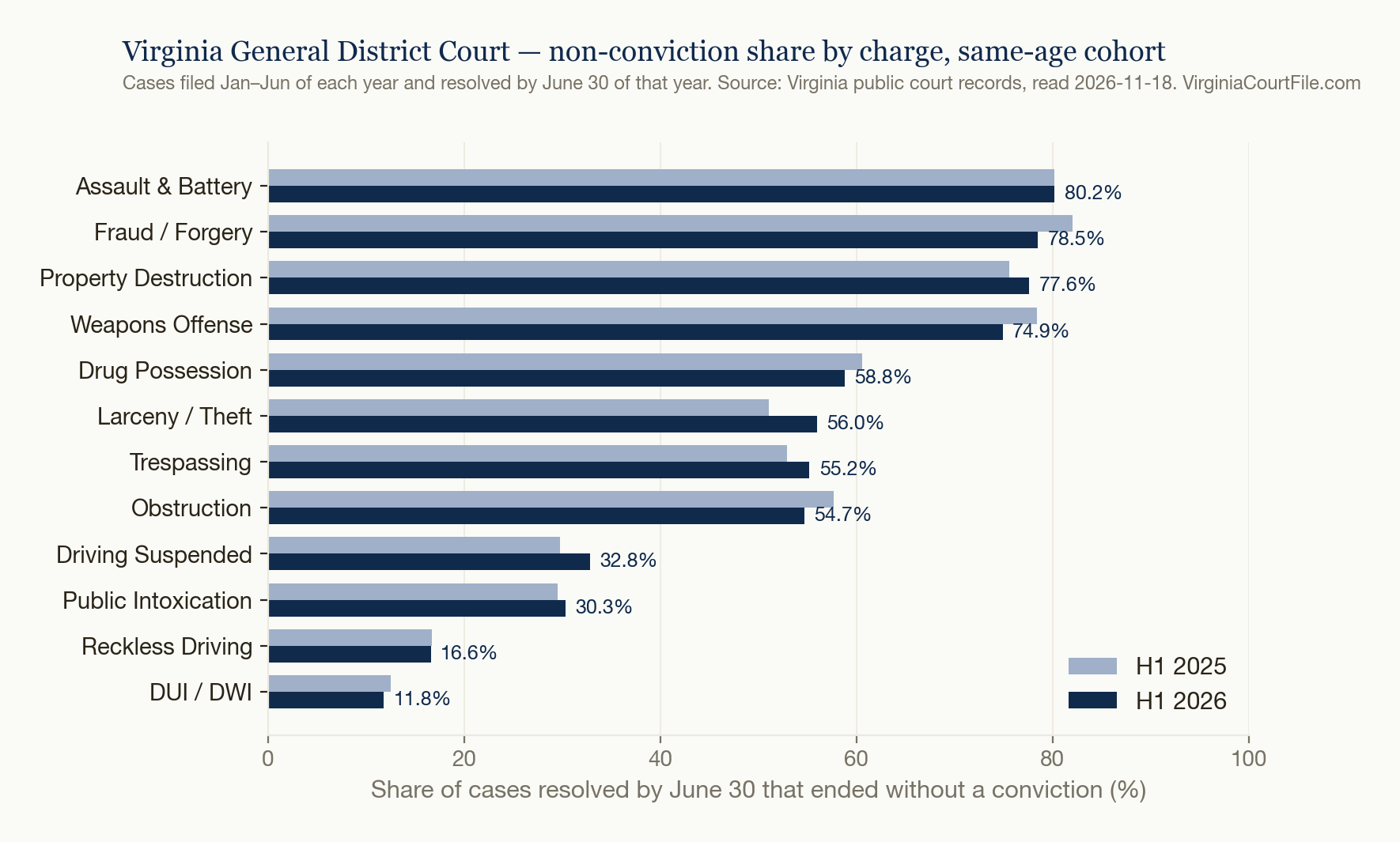
| Charge category | Filed 2026 | Resolved by Jun 30, 2026 | No conviction 2025 | No conviction 2026 | Change | Reduced 2025 | Reduced 2026 |
|---|---|---|---|---|---|---|---|
| Reckless Driving | 49,334 | 22,223 | 16.7% | 16.6% | -0.1 pts | 46.5% | 48.8% |
| Larceny / Theft | 17,937 | 5,537 | 51.1% | 56.0% | +4.9 pts | 3.1% | 3.4% |
| Driving Suspended | 12,536 | 5,062 | 29.8% | 32.8% | +3.0 pts | 19.8% | 15.4% |
| DUI / DWI | 11,072 | 3,029 | 12.5% | 11.8% | -0.7 pts | 30.4% | 30.1% |
| Assault & Battery | 9,858 | 3,379 | 80.2% | 80.2% | +0.0 pts | 4.8% | 4.9% |
| Public Intoxication | 9,829 | 4,476 | 29.5% | 30.3% | +0.8 pts | 0.0% | 0.0% |
| Drug Possession | 9,138 | 1,297 | 60.6% | 58.8% | -1.8 pts | 30.7% | 30.8% |
| Weapons Offense | 8,087 | 1,729 | 78.4% | 74.9% | -3.5 pts | 2.7% | 2.9% |
| Trespassing | 6,201 | 2,659 | 52.9% | 55.2% | +2.3 pts | 0.3% | 0.3% |
| Fraud / Forgery | 4,942 | 1,216 | 82.0% | 78.5% | -3.5 pts | 4.8% | 4.4% |
| Obstruction | 4,373 | 1,393 | 57.7% | 54.7% | -3.0 pts | 2.2% | 2.8% |
| Property Destruction | 3,414 | 1,071 | 75.6% | 77.6% | +2.0 pts | 5.1% | 5.3% |
“Reduced” means the case ended in a conviction and the charge of record had been amended from the charge filed; it is a share of all resolved cases in the category, so it can only rise if convictions rise or if more convictions are to an amended charge. The record does not say whether the amended charge is less serious.
3. By jurisdiction: the same charge still resolves very differently by county
Among the 52 jurisdictions with at least 300 cases resolved by June 30 in both years, the non-conviction share in the first half of 2026 ranged from 2.9% in Greensville County to 73.2% in Russell County. That spread is the same order of magnitude as in the 2025 Year in Review: where a case is heard remains a larger factor in how it ends than the year it was filed.
The 25 largest jurisdictions by first-half 2026 filings
| Jurisdiction | Filed 2026 | Resolved by Jun 30 | No conviction 2025 | No conviction 2026 | Change |
|---|---|---|---|---|---|
| Fairfax County | 14,122 | 4,939 | 39.8% | 45.7% | +5.9 pts |
| Virginia Beach | 8,098 | 2,650 | 30.5% | 33.5% | +3.0 pts |
| Prince William County | 7,302 | 1,991 | 40.9% | 42.4% | +1.5 pts |
| Henrico County | 6,329 | 1,912 | 40.5% | 40.7% | +0.2 pts |
| Chesterfield County | 6,274 | 2,024 | 48.9% | 47.6% | -1.3 pts |
| Richmond City | 4,861 | 1,990 | 68.9% | 62.3% | -6.6 pts |
| Newport News | 4,856 | 1,542 | 55.9% | 51.9% | -4.0 pts |
| Norfolk | 3,970 | 1,554 | 59.8% | 53.0% | -6.8 pts |
| Chesapeake | 3,411 | 1,045 | 44.3% | 47.1% | +2.8 pts |
| Loudoun County | 3,313 | 1,443 | 34.2% | 38.0% | +3.8 pts |
| Arlington County | 3,238 | 1,300 | 49.5% | 57.3% | +7.8 pts |
| Hampton | 3,083 | 1,232 | 50.5% | 42.5% | -8.0 pts |
| Rockingham County | 3,006 | 1,175 | 27.9% | 28.6% | +0.7 pts |
| Roanoke City | 2,716 | 1,407 | 43.1% | 41.6% | -1.5 pts |
| Stafford County | 2,528 | 836 | 39.4% | 35.8% | -3.6 pts |
| Hanover County | 1,971 | 587 | 21.4% | 24.7% | +3.3 pts |
| Smyth County | 1,945 | 704 | 12.2% | 7.7% | -4.5 pts |
| Suffolk | 1,938 | 466 | 46.2% | 41.8% | -4.4 pts |
| Spotsylvania County | 1,936 | 651 | 40.5% | 27.5% | -13.0 pts |
| Northampton County | 1,911 | 759 | 9.2% | 10.1% | +0.9 pts |
| Lynchburg | 1,900 | 681 | 39.8% | 39.8% | +0.0 pts |
| Portsmouth | 1,765 | 828 | 58.1% | 58.3% | +0.2 pts |
| Albemarle County | 1,715 | 659 | 37.7% | 35.8% | -1.9 pts |
| Danville | 1,704 | 739 | 48.0% | 47.2% | -0.8 pts |
| Montgomery County | 1,694 | 562 | 30.6% | 37.4% | +6.8 pts |
Largest moves, either direction
A move of several points on a few hundred resolved cases is within the range a single busy docket can produce. These are listed for completeness, not as findings; none is attributed to a cause.
| Jurisdiction | Resolved 2025 / 2026 | No conviction 2025 | No conviction 2026 | Change |
|---|---|---|---|---|
| Charlottesville | 325 / 347 | 37.8% | 50.7% | +12.9 pts |
| Mecklenburg County | 410 / 364 | 12.9% | 24.2% | +11.3 pts |
| Pulaski County | 396 / 413 | 21.7% | 31.0% | +9.3 pts |
| Arlington County | 1,185 / 1,300 | 49.5% | 57.3% | +7.8 pts |
| Montgomery County | 562 / 562 | 30.6% | 37.4% | +6.8 pts |
| Spotsylvania County | 755 / 651 | 40.5% | 27.5% | -13.0 pts |
| Accomack County | 558 / 396 | 35.5% | 22.7% | -12.8 pts |
| Franklin County | 431 / 374 | 46.9% | 35.8% | -11.1 pts |
| Wythe County | 514 / 353 | 34.0% | 25.2% | -8.8 pts |
| Hampton | 1,179 / 1,232 | 50.5% | 42.5% | -8.0 pts |
4. One in five convictions was entered without the defendant in court
Virginia General District Courts can find a defendant guilty in absentia when the defendant does not appear. In the first half of 2026, 7,570 of the 34,712 convictions entered by June 30 — 21.8% — were recorded as guilty in absentia. Read the same way, the share in the first half of 2025 was 23.0% (8,426 of 36,603), a move of -1.2 points.
For a person facing a district-court charge, this is the number to notice: an in-absentia conviction carries the same record as any other. The public record does not say why a defendant did not appear, and this report draws no conclusion from it.
What methodology issues affect a mid-year read of Virginia district court data?
Cohort age — the reason both years are read at June 30
By 2026-11-18, 35.4% of the cases filed in the first half of 2026 had a final disposition recorded by June 30 of that year; for the first half of 2025 read at its own June 30 the figure was 36.9%. Cases that resolve within a few months of filing skew toward quick pleas and prepaid tickets, while dismissals and contested trials take longer. Comparing 2026 with the whole of 2025 would therefore read as a change in outcomes what is really a difference in age. Reading both years at the same point in their life removes that bias but also means every rate here describes early-resolving cases only; the full-year picture for 2026 will not be readable until 2027.
Recording gaps in the 2026 record
VirginiaCourtFile reads Virginia’s public court records by hearing date. Edition 1 of this report (October 19, 2026) disclosed 31 court days in 2026 on which the daily read had not run (May 4–14 and September 18–October 19). Those days have since been re-read, and this edition re-derives every figure from the fuller record. 2 court days remain incompletely read (2026-09-18, 2026-11-18); a case whose only hearing fell on one of those days is absent from this report. The effect on rates is small because the missing days are not selected by outcome, but it is one reason the filed counts below are labeled as recorded and no year-over-year filing change is published.
| Month filed | Recorded, 2025 | Recorded, 2026 | 2026 as share of 2025 |
|---|---|---|---|
| January | 26,095 | 24,798 | 95.0% |
| February | 22,444 | 21,834 | 97.3% |
| March | 27,286 | 28,568 | 104.7% |
| April | 27,403 | 27,496 | 100.3% |
| May | 26,741 | 25,960 | 97.1% |
| June | 26,557 | 27,723 | 104.4% |
A month reading a few percent above or below the prior year is within what recording differences alone produce. Per VirginiaCourtFile’s same-age rule, a difference of a few percent is not published as a change when the measurement error is itself a few percent.
Why Circuit Court is not in this report
Circuit Court filings for June 2026 were still well below their eventual level in the public record when this report was prepared, and a Circuit Court number read early revises for weeks afterward — the Q1 2026 Circuit Court report had to be publicly restated for exactly that reason. General District Court records do not carry the indictment lag, so the mid-year read is district only. Felony cases that moved to Circuit Court by certification are counted as filed here but not as resolved.
Which findings were deliberately held from publication — and why?
- Resolution pace. The share of filings resolved within the half-year reads lower in 2026 than in 2025 for every filing month. The same audit found that final dispositions from hearings in July, August and September 2026 were captured at 65.0%, 67.0% and 71.6% of the 2025 level, so the pace difference cannot be separated from the recording lag. It is held until the finalized cases are re-read.
- Year-over-year filing change. Edition 1 held this because recorded 2026 filings sat a few percent below 2025 and the recording gaps were the same size. With those days re-read, recorded 2026 filings came within a fraction of one percent of 2025. That is inside the measurement tolerance of the same-age rule, so it is reported as no measurable change rather than as a change in either direction.
- Officer-level shifts. Published separately, with their own thresholds, in the Officer Trends, H1 2026 report.
- Race and ethnicity. The “Hispanic” value in the court record remains severely under-recorded; no breakdown is published.
How was this report built? (Methodology)
Data source. Virginia Online Case Information System (CIS) — the public court records published by the Virginia Judicial System. Every figure was derived on 2026-11-18 from the General District Court record by one audit script; the run log is preserved with the report.
Universe. Cases filed in Virginia General District Courts between January 1 and June 30 of each year, across 125 jurisdictions, in the charge categories the 2025 Year in Review covers. Traffic infractions, failure-to-appear dockets, probation-violation dockets and uncategorized charges are excluded. Charge categories are assigned statute-first, exactly as on every charge page on this site.
Resolved. A case is resolved if its final disposition is guilty, not guilty, dismissed or nolle prosequi and the hearing that finalized it took place on or before June 30 of the filing year. Cases certified to Circuit Court, prepaid, transferred, or still pending are filed but not resolved. Rates divide by resolved cases.
No conviction is dismissed, nolle prosequi or acquitted. Reduced is a conviction where the charge of record had been amended from the charge filed. Guilty in absentia is the court’s own disposition code.
Thresholds. Charge categories appear with at least 1,000 resolved cases in both years; jurisdictions with at least 300. Smaller groups are aggregated into the statewide figures but not shown on their own.
What this report does not capture
- Causation. The data shows what happened, not why. Prosecutorial policy, docket load, plea practice and enforcement priorities are not observable in the record and are not inferred.
- Late-resolving cases. Everything here describes cases resolved within a few months of filing. Cases that took longer — typically the contested ones — are not yet in the 2026 figures.
- Circuit Court. Felony outcomes and appeals are not included. Cases certified to Circuit Court appear as filed, not resolved.
- Judges and prosecutors. The district-court record names neither the judge nor the individual prosecutor on a case.
- Counsel. Whether a defendant was represented, and whether counsel was retained or appointed, is not reliable in the record and is not used.
- Severity of a reduced charge. “Reduced” means amended; the record does not confirm the amended charge is less serious.
- The days not read. Cases whose only hearing fell on the 2 unread 2026 court days listed above.
Editorial standards. This report observes; it does not recommend. Every number can be re-derived from the public record by the audit script kept with the report, and the figures will be re-derived when the unread court days have been captured.
Suggested citation: VirginiaCourtFile.com. (2026). Virginia District Court Outcomes, First Half of 2026, Edition 2 (2026-11-18). Retrieved from https://www.virginiacourtfile.com/research/h1-2026-district-court
Source: Virginia Online Case Information System (CIS), public court records, General District Courts, cases filed January 1, 2025 – June 30, 2026, read 2026-11-18. Every published number is reproducible from the source records.
Not legal advice. This report describes patterns in Virginia court records. Nothing here should be construed as legal advice or as a prediction for any specific case. A person facing a charge should consult a licensed Virginia attorney.