Quarterly Research Report · Published May 9, 2026 · Restated July 30, 2026 · Methodology
Virginia Circuit Court Filings, Q1 2026 vs Q1 2025
82,024 charges across 119 jurisdictions · 30 of 31 judicial circuits
This report compares 41,413 charges filed in Virginia Circuit Courts during Q1 2025 against 40,611 filed during Q1 2026 — a 1.9% year-over-year decline. The decline is concentrated in new-offense filings (−3.5% excluding probation violation reviews), and the five principal drug codes account for nearly all of the net drop. But the headline drug-prosecution decline is largely a timing artifact of batched grand jury indictments in two specific jurisdictions, not a policy shift.
Published by VirginiaCourtFile.com from public Virginia court records. All statistics independently verifiable against the source data. The 19th Judicial Circuit (Fairfax County, Fairfax City, Falls Church) is excluded — that circuit operates outside Virginia's statewide Case Information System.
In this report
- For substantive new-offense charges, median takes 145 days from offense to indictment
- Total filings declined 1.9%, a direction confirmed at three independent measurement levels
- The decline is concentrated in new-offense filings, not probation reviews
- Drug prosecutions down 21% — but mostly batched-indictment timing
- Richmond Metro declined; Northern Virginia grew; Hampton Roads was roughly flat
- Reckless driving filings in circuit court fell about 9%
- Domestic violence prosecution mix shifted
- Felon-in-possession and firearm-with-drug declined; use-of-firearm charges edged up
- Hampton Roads jurisdictions diverged significantly from each other
- February 2026 was up year-over-year — but the gain was procedural
- What methodology issues affect year-over-year comparisons of Virginia court filing data?
- Which findings were deliberately held from publication — and why?
1. For substantive new-offense charges, median takes 145 days from offense to indictment
Computed from (Filed date − Offense date) on each charge. Roughly 16–17% of all circuit court charges (probation violation reviews under § 19.2-306, contempt charges under § 18.2-456, bond appeals under § 19.2-124, and similar procedural codes) have the same offense date and filing date by definition — they are not new offenses but procedural events on existing matters. The substantive case-aging metric below excludes those zero-day records.
| Statistic (substantive new-offense charges only) | Q1 2025 | Q1 2026 |
|---|---|---|
| Median days from offense to filing | 139 | 145 |
| Average days from offense to filing | 531 | 508 |
| 90th percentile (slow tail) | 1,336 | 1,356 |
| Charges in this universe | 34,803 | 33,760 |
For comparison, including all 82,024 charges (procedural events folded in), the medians compress to 107 days for Q1 2025 and 108 days for Q1 2026 — but those include 6,610 and 6,851 zero-day procedural records respectively, where there is no separate offense date to measure against.
This metric does not appear in any published Virginia court statistic. We publish it because defendants, defense attorneys, journalists, reformers, and prosecutors all have a stake in understanding how long the case-aging pipeline takes.
2. Total filings declined 1.9%, a direction confirmed at three independent measurement levels
Total charges filed dropped from 41,413 to 40,611 — a 1.9% decline. The same direction appears at the level of distinct defendants (−1.4%), distinct (defendant, jurisdiction) pairs (−1.8%), and distinct offender tracking numbers (−2.5%). Charges per defendant were essentially unchanged (2.34 → 2.33), meaning the decline reflects fewer people being charged, not the same people being charged with more counts.
| Measure | Q1 2025 | Q1 2026 | Δ |
|---|---|---|---|
| Total charges filed | 41,413 | 40,611 | −1.9% |
| Distinct defendants | 17,662 | 17,419 | −1.4% |
| Distinct OTNs | 38,961 | 37,979 | −2.5% |
| Charges per defendant | 2.34 | 2.33 | −0.6% |
| Felony charges | 27,108 | 26,358 | −2.8% |
| Misdemeanor charges | 10,682 | 10,550 | −1.2% |
| Other charge types (animal violations, bond appeals, infractions, civil) | 3,623 | 3,703 | +2.2% |
3. The decline is concentrated in new-offense filings, not probation violation reviews
A large component of circuit court activity consists of probation violation reviews (Va. Code § 19.2-306) — proceedings on prior convictions, not new charges. These grew slightly year-over-year (12,792 → 12,995, +1.6%). Excluding them, new-offense and other procedural filings dropped from 28,621 to 27,616, a 3.5% decline.
Probation violation reviews are not "less significant" than new-offense filings — they directly affect defendants' liberty, since probation can be revoked and result in incarceration. We separate them here only because they followed a different year-over-year pattern.
| Category | Q1 2025 | Q1 2026 | Δ |
|---|---|---|---|
| Probation violation reviews (§ 19.2-306) | 12,792 | 12,995 | +1.6% |
| All other charges (new offense + other procedural) | 28,621 | 27,616 | −3.5% |
| Total | 41,413 | 40,611 | −1.9% |
Of the 1,005-charge decline in non-probation-review filings, the five principal drug-family codes accounted for 967 (96%) and homicide-family charges for another 73 — offset by small increases distributed across other categories.
4. Drug prosecution filings declined 21% — but most of the headline reflects timing variance
Across the five principal drug-related code sections, charges filed in circuit court dropped from 4,596 to 3,629 — a 21.0% decline.
| Code | Description | Q1 2025 | Q1 2026 | Δ |
|---|---|---|---|---|
| § 18.2-248 | Manufacture / distribute Sch. I/II | 1,544 | 737 | −52% |
| § 18.2-248.1 | Distribute marijuana 1 oz – 5 lb | 174 | 121 | −30% |
| § 18.2-250 | Possess Sch. I/II | 2,720 | 2,661 | −2% |
| § 18.2-251 | First-offender drug program | 128 | 103 | −20% |
| § 18.2-258 | Drug paraphernalia | 30 | 7 | −77% |
| Drug-family combined (5 codes) | 4,596 | 3,629 | −21% | |
CIS-format subsection variants of these five codes (e.g., "18.2-250(A)(A)," "18.2-248.01") add approximately 160 charges across both quarters combined and follow the same direction; aggregate figures shown reflect the principal code only.
The data points to timing variance in coordinated grand jury indictment events. Suffolk's Q1 2025 included 852 charges filed as Direct Indictments — 60.3% of Suffolk's 1,412 total Q1 filings. The other six core Hampton Roads jurisdictions combined for a 5.9% Direct-Indictment share that quarter (Portsmouth 16.5%, Norfolk 10.7%, Virginia Beach 5.8%, Chesapeake 4.3%, Hampton 3.5%, Newport News 0.8%). Tazewell's Q1 2025 included two single days with more than 100 charges each (247 charges on January 31; 176 on January 14). Q1 2026 had no comparable batched events in either jurisdiction. Excluding Suffolk and Tazewell, statewide § 18.2-248 distribution filings declined approximately 30% — still meaningful, but materially smaller than the headline suggests.
5. Richmond Metro declined; Northern Virginia grew; Hampton Roads was roughly flat
Three named urban regions plus the rest of the state:
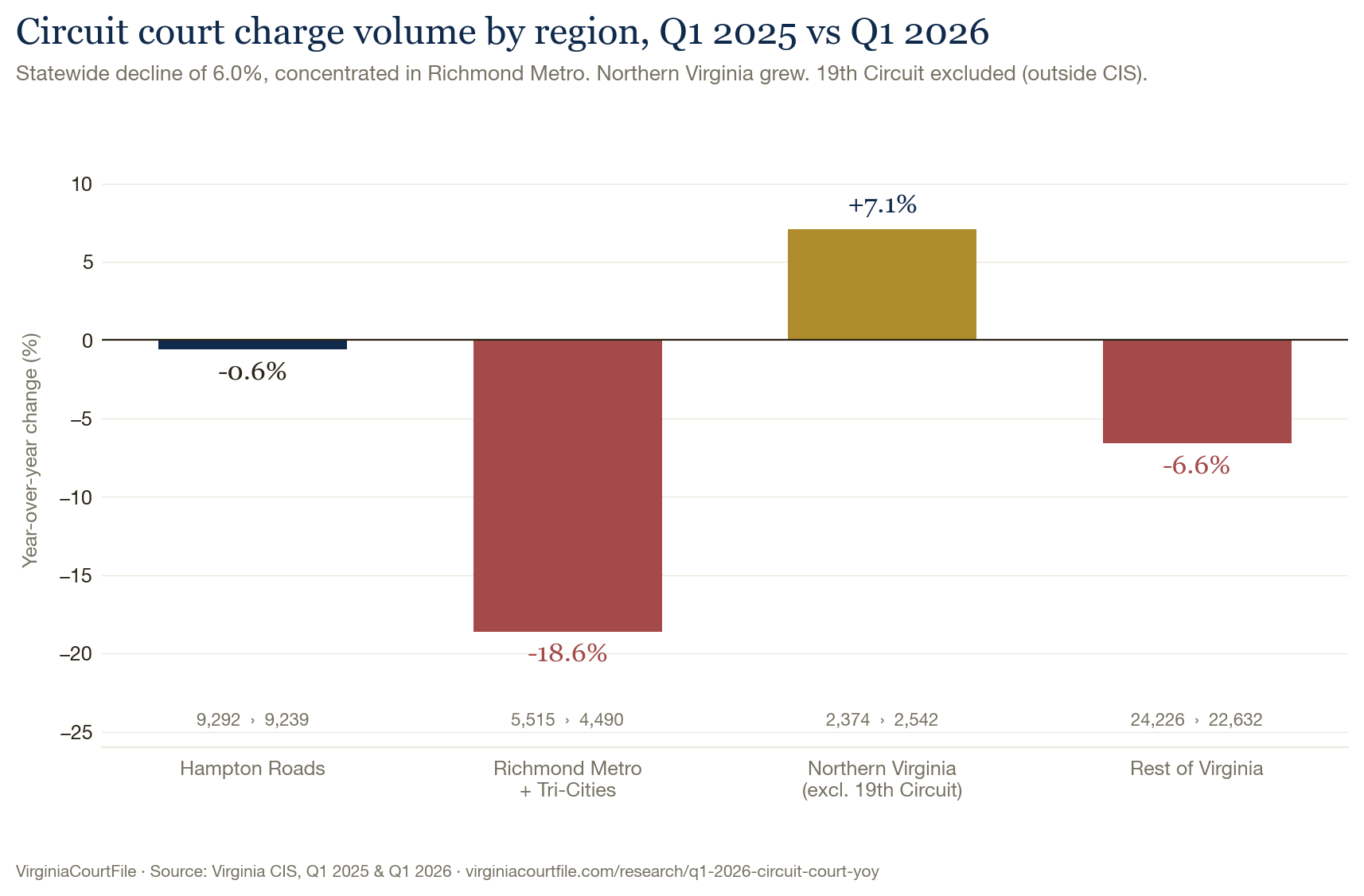
| Region | Q1 2025 | Q1 2026 | Δ |
|---|---|---|---|
| Hampton Roads (13 jurisdictions) | 9,292 | 9,471 | +1.9% |
| Richmond Metro + Tri-Cities (11 jurisdictions) | 5,517 | 4,989 | −9.6% |
| Northern Virginia (excl. 19th Circuit, 6 jurisdictions) | 2,374 | 2,582 | +8.8% |
| Rest of Virginia (89 jurisdictions) | 24,230 | 23,569 | −2.7% |
| Statewide (excl. 19th Circuit) | 41,413 | 40,611 | −1.9% |
- Hampton Roads (Hampton Roads Planning District Commission): Virginia Beach (810), Newport News (700), Norfolk (710), Chesapeake (550), Hampton (650), Portsmouth (740), Suffolk (800), Williamsburg/James City (830), York (199), Gloucester (073), Isle of Wight (093), Southampton (175), Northampton (131).
- Richmond Metro + Tri-Cities (PlanRVA + Crater): Richmond City (760), Henrico (087), Chesterfield (041), Hanover (085), Goochland (075), Powhatan (145), New Kent (127), Charles City (036), Colonial Heights (570), Hopewell (670), Petersburg (730).
- Northern Virginia, excluding 19th Circuit: Arlington (013), Loudoun (107), Prince William (153), Alexandria (510), Manassas (683), Manassas Park (685). Fairfax County (059), Fairfax City (600), and Falls Church (610) operate outside the statewide CIS and are not in this dataset.
- Rest of Virginia: the remaining 89 jurisdictions with circuit court filings during the period.
Richmond Metro + Tri-Cities saw a 9.6% decline driven by Chesterfield (−21.1%, a drop of 246 charges), Petersburg (−40.5%, −193 charges), Richmond City (−17.0%, −157), and Hanover (−8.1%); Henrico was essentially flat (+0.8%). Northern Virginia (excluding the 19th Circuit) grew 8.8%, led by Prince William (+10.1%) and Loudoun (+14.2%). Hampton Roads as a region grew slightly — but that aggregate masks substantial variation within the region (see Finding 9). The Rest-of-Virginia bucket combines 89 mostly smaller jurisdictions across Southwest Virginia, the Shenandoah Valley, Southside, the Northern Neck and Eastern Shore, the Roanoke and Lynchburg areas, and the Charlottesville and Fredericksburg corridors.
Top 15 jurisdictions by Q1 2025 charge volume
| Jurisdiction | Q1 2025 | Q1 2026 | Δ |
|---|---|---|---|
| Virginia Beach | 1,696 | 1,963 | +15.7% |
| Henrico | 1,680 | 1,693 | +0.8% |
| Suffolk | 1,412 | 979 | −30.7% |
| Chesapeake | 1,399 | 1,491 | +6.6% |
| Chesterfield | 1,166 | 920 | −21.1% |
| Norfolk | 1,094 | 1,039 | −5.0% |
| Prince William | 1,075 | 1,184 | +10.1% |
| Tazewell | 1,028 | 713 | −30.6% |
| Hampton | 1,024 | 966 | −5.7% |
| Spotsylvania | 933 | 1,007 | +7.9% |
| Richmond City | 923 | 766 | −17.0% |
| Newport News | 903 | 1,322 | +46.4% |
| Rockingham | 817 | 896 | +9.7% |
| Stafford | 755 | 719 | −4.8% |
| Danville | 688 | 664 | −3.5% |
The 15 largest jurisdictions account for 16,593 of 41,413 Q1 2025 charges (40%). They moved in both directions year-over-year: seven grew, eight declined. Among the steep declines, Suffolk, Tazewell, and Chesterfield have the largest absolute drops; for context on Suffolk and Tazewell see Finding 4 (drug-prosecution timing variance), and on Newport News' increase see Finding 9.
6. Reckless driving filings in circuit court fell about 9%
Most reckless driving cases in Virginia resolve as misdemeanors at the lower court level; circuit court filings reflect felony-grade reckless driving (typically high-speed or repeat-offender) or cases that have moved up on appeal. Counting all CIS-format variants of each code section (e.g., the principal entry plus subsection-prefixed variants such as "A.46.2-862," "C.46.2-862"):
| Code | Description | Q1 2025 | Q1 2026 | Δ |
|---|---|---|---|---|
| § 46.2-862 | Reckless driving (excessive speed, all variants) | 443 | 386 | −13% |
| § 46.2-852 | General reckless driving (all variants) | 148 | 155 | +5% |
| § 46.2-853 | Faulty equipment / brakes (all variants) | 47 | 38 | −19% |
| Three principal codes combined | 638 | 579 | −9% | |
A 9% decline in circuit court reckless driving filings could reflect any combination of fewer felony-grade incidents, fewer cases moved up on appeal, or charging-stage decisions. The data does not distinguish among these possibilities. (Across all reckless-driving code sections in the § 46.2-852 through § 46.2-869 family combined — including less common codes — the total fell from 705 to 658, a 6.7% decline.)
7. Domestic violence prosecution mix shifted
Among charges related to domestic violence:
| Code | Description | Q1 2025 | Q1 2026 | Δ |
|---|---|---|---|---|
| § 18.2-57 | Simple assault and battery | 685 | 710 | +4% |
| § 18.2-57.2 | Assault on family or household member | 409 | 400 | −2% |
| § 18.2-51.6 | Strangulation of family or household member | 239 | 205 | −14% |
| § 16.1-253.2 | Violation of protective order | 186 | 246 | +32% |
The pattern itself is the finding: enforcement of pretrial restrictions (protective orders) increased while charging of the most aggravated offense in the family (strangulation) decreased. This dataset does not capture incident-level data, so the underlying drivers are not observable.
8. Felon-in-possession and firearm-with-drug declined; use-of-firearm charges edged up
| Code | Description | Q1 2025 | Q1 2026 | Δ |
|---|---|---|---|---|
| § 18.2-308.2 | Possession of firearm by convicted felon | 688 | 631 | −8% |
| § 18.2-308.4 | Possession of firearm while in possession of drug | 311 | 254 | −18% |
| § 18.2-53.1 | Use of firearm in commission of felony | 306 | 318 | +4% |
| § 18.2-308 | General firearm violations | 175 | 191 | +9% |
The 18% decline in firearm-while-in-possession-of-drug filings (§ 18.2-308.4) is consistent with the broader drug-prosecution pattern. Use-of-firearm-in-commission-of-felony (§ 18.2-53.1) — which carries a mandatory enhanced sentence — rose slightly, as did general firearm violations.
9. Hampton Roads jurisdictions diverged significantly from each other
Within the Hampton Roads region, the year-over-year pattern was bifurcated rather than uniform:
| Jurisdiction | Q1 2025 | Q1 2026 | Δ |
|---|---|---|---|
| Newport News | 903 | 1,322 | +46.4% |
| Gloucester | 270 | 379 | +40.4% |
| Virginia Beach | 1,696 | 1,963 | +15.7% |
| Chesapeake | 1,399 | 1,491 | +6.6% |
| Southampton | 200 | 206 | +3.0% |
| Williamsburg / James City | 243 | 250 | +2.9% |
| Isle of Wight | 144 | 139 | −3.5% |
| Norfolk | 1,094 | 1,039 | −5.0% |
| Hampton | 1,024 | 966 | −5.7% |
| Portsmouth | 424 | 396 | −6.6% |
| Northampton | 167 | 140 | −16.2% |
| Suffolk | 1,412 | 979 | −30.7% |
| York | 316 | 201 | −36.4% |
Newport News' +46.4% increase is concentrated in bond-appeal entries (Va. Code § 19.2-124), which jumped from 169 to 372 — primarily through new charge-tagged labels that did not appear in 2025. This pattern is consistent with — but does not confirm — a clerical recording change to the Newport News docketing system. Confirmation would require contact with the Newport News Circuit Court Clerk's office. Excluding bond-appeal entries, Newport News' substantive offense filings increased approximately 29%.
10. February 2026 was up year-over-year — but the gain was procedural
Within the quarter, the year-over-year decline was not month-uniform:
| Month | Q1 2025 | Q1 2026 | Δ |
|---|---|---|---|
| January | 13,998 | 12,522 | −10.5% |
| February | 12,079 | 13,047 | +8.0% |
| March | 15,336 | 15,042 | −1.9% |
February 2026 was 968 charges higher than February 2025. Of that increase, 622 charges (64%) came from procedural codes — probation violation reviews (+312), bond appeals (+220), and contempt (+90). New-offense charging in February moved much less. The bumpy month-by-month pattern reflects procedural docket activity that does not align cleanly with new-charging activity.
What methodology issues affect year-over-year comparisons of Virginia court filing data?
Three structural issues confound naïve year-over-year comparisons of Virginia circuit court filing data: filing-data maturation (charges continue to be indexed for weeks after a quarter closes, so the newer period reads artificially low), charge-label proliferation (a pattern consistent with multi-count indictments being recorded as separate rows per count, inflating 2026 label counts), and batched grand jury indictment timing (single-day mass filings distort quarterly comparisons). VirginiaCourtFile documents them here because any researcher using this data will face them, and because they reshaped the publishable findings of this report itself.
Filing-data maturation — the reason this report was restated
Circuit court filings continue to be indexed in the public record for weeks after a quarter closes. When this report was first published on May 9, 2026, the Q1 2026 quarter read 38,903 charges; by July 30, 2026, the same quarter reads 40,611 — 1,708 additional charges (+4.4%) that were filed during the quarter but had not yet been indexed at publication. The comparison quarter, Q1 2025, was essentially static over the same period (41,407 → 41,413). The result: the originally published 6.0% year-over-year decline was mostly a maturation artifact; the mature figure is 1.9%.
Implication: a year-over-year comparison run within roughly two months of quarter close will systematically overstate decline (or understate growth) in the newer period, because the older period is complete and the newer one is not. Every figure on this page was re-derived from the matured record on July 30, 2026, and VirginiaCourtFile now applies a temporal-maturity gate before publishing any circuit-court period comparison.
Charge-label proliferation in 2026
Some code sections show substantially more distinct charge labels in Q1 2026 than in Q1 2025, even when the underlying total volume is similar. The clearest example is § 18.2-374.1:1 (child pornography possession / distribution), where the label count rose from 21 distinct labels in Q1 2025 to 69 in Q1 2026 — many of the new labels carrying sequential numerical suffixes (e.g., "POSS CHILD PORN 2+ OFF #5," "#6," through "#19"). This pattern is consistent with a clerical change to record multi-count indictments as separate rows per count rather than a single labeled entry. Statewide, charges with sequential "#N" suffixes rose from 2.16% of all filings in Q1 2025 to 2.61% in Q1 2026.
Implication: charge-level year-over-year comparisons within affected code sections may overstate apparent growth. Aggregation to code-section totals neutralizes this issue; that is the approach this report uses.
Batched grand jury indictment timing
Several Virginia jurisdictions use coordinated grand jury sessions to indict multiple defendants at once, often as the result of multi-month task force investigations. In the most extreme examples in Q1 2025, a single court filed more than 240 charges on a single day (Suffolk filed 293 charges on January 24, 2025, and 253 on March 14; Tazewell filed 247 charges on January 31, 2025). Other jurisdictions had more modest but still concentrated batched events (Chesterfield filed 121 charges on March 17, 2025). Quarterly comparisons that include such an event in one period but not the other will show large apparent year-over-year changes that do not reflect underlying changes in court or office activity. This report documents at least three jurisdictions where this pattern materially affected Q1 2026 vs Q1 2025 comparisons: Suffolk, Tazewell, and Chesterfield.
Implication: drug-prosecution and other major-prosecution year-over-year comparisons in Virginia should ideally use annual or rolling-12-month windows, not quarterly windows, to reduce sensitivity to grand jury session timing.
Which findings were deliberately held from publication — and why?
Five patterns visible in the Virginia circuit court filing data behind this report are deliberately not published as findings, either pending external verification or because the underlying data quality does not support a publishable claim. VirginiaCourtFile lists them so readers know what was considered and why it was held.
- Homicide-family charges declined 33.5% year-over-year (218 → 145), concentrated geographically (Richmond City alone accounts for roughly a third of the statewide drop). The within-data finding is robust, but a homicide-related claim requires cross-checking against Virginia State Police Uniform Crime Reports and Richmond Police Department data before publication. We hold this finding until that external verification is complete.
- Sexual assault Class 2 felony charges (§ 18.2-67.1) declined 42.5% (134 → 77). While the percentage is striking, the small base makes single-quarter comparisons vulnerable to noise. We hold this finding pending trend confirmation across additional quarters.
- Newport News bond-appeal recording change — described above as "consistent with" a clerical change. Confirmation requires contact with the Newport News Circuit Court Clerk's office.
- Race breakdowns of defendants are not published because the "Hispanic" value in the CIS Race field is severely under-recorded (only 2 defendants coded Hispanic in Q1 2025; 26 in Q1 2026 — both implausibly low for Virginia's population). Any racial-disparity analysis from this data alone would be unreliable.
- Defense attorney representation appears to have dropped about 5 percentage points year-over-year (96.9% of Q1 2025 charges have a recorded defense attorney vs 91.6% for Q1 2026). This is almost certainly a maturity artifact: many Q1 2026 cases have not yet had attorneys appointed or recorded — and consistent with that explanation, the gap has narrowed as the data has matured (it read 9 points in May 2026). The right comparison is at a constant maturity window. We do not publish this finding.
How was this report built? (Methodology)
Data source. Virginia Online Case Information System (CIS) — the public court records published by the Virginia Judicial System. VirginiaCourtFile aggregates these records daily and presents them in structured form for analysis. Every record visible in this report is also visible to anyone with access to the same public court information.
Universe. Charges filed in Virginia Circuit Courts between January 1 and March 31 of each year, across 119 jurisdictions with circuit court filings during the period. The 19th Judicial Circuit (Fairfax County, Fairfax City, Falls Church) operates outside the statewide CIS via the Court Public Access Network, which prohibits automated collection. References to "statewide" in this report mean 30 of 31 judicial circuits, covering 119 of Virginia's 122 reporting jurisdictions.
Counting unit. Charges, not unique cases or defendants. One person can have multiple charges; one case can have multiple charges. Where defendant counts or distinct OTNs are presented, they are labeled as such.
Date field. "Filed" date — the date the charge was filed in Circuit Court (typically post-indictment for felonies). This differs from arrest date and from any earlier court filing in the same matter. Charges filed in Q1 of a calendar year may have offense dates in any prior period.
Verification. Every numeric claim in this report is derived from public Virginia court records. Figures were re-derived from source data on the publication date (May 9, 2026) and again on July 30, 2026, after the data-maturation window closed; the July 30 derivation is what this page reports (see "Filing-data maturation" under Methodology issues). Researchers seeking access to the underlying record set may contact us.
What this report does not capture
- Causation. The data shows what happened, not why. Possible drivers of any pattern observed (prosecutorial discretion, policy shifts, demographic changes, enforcement priorities, court calendaring, federal-state venue shifts) are not observable from this dataset.
- Severity within charges. A felony charge can be Class 1 through Class 6, with very different consequences. Aggregate counts hide this distinction.
- Disposition outcomes. Q1 2026 cases are mostly still pending. Comparing total disposition mix year-over-year would mislead, since Q1 2025 cases have had 14 or more months to resolve while Q1 2026 cases have had 1–4 months.
- Plea dynamics. What was pled to, what was reduced, what was dismissed in exchange for what — not visible from filing data alone.
- Upstream pipeline. Arrest counts, declined prosecutions at the lower-court level, and grand jury throughput would inform the upstream side of any decline. This report uses Circuit Court filings only and makes no claim about activity earlier in the criminal-justice pipeline.
- The 19th Judicial Circuit. Not in this dataset.
- Civil cases. This report covers Circuit Criminal Court only.
Editorial standards. This report observes; it does not recommend. Numbers are sourced and cited rather than editorialized. Findings that depend on data quality issues are either reframed at the appropriate level of aggregation or held from publication.
For analytics platforms + researchers: the underlying data layer behind this report can be made available under a partnership arrangement — scope, refresh cadence, and indemnification discussed case-by-case at VCF Intelligence.
Suggested citation: VirginiaCourtFile.com. (May 2026, restated July 2026). Virginia Circuit Court Q1 2026 Report: Filings Down 1.9%. Retrieved from https://www.virginiacourtfile.com/research/q1-2026-circuit-court-yoy
Source: Virginia Online Case Information System (CIS), public court records covering 119 of 122 reporting jurisdictions, January 1, 2025 – March 31, 2026. Every published number was re-derived from source records on July 30, 2026.
Not legal advice. This report describes patterns in Virginia court filings. Nothing here should be construed as legal advice or as a recommendation for any specific case, defendant, or proceeding.